The lamp is on. Almost nothing is visible.
Staying
Four rooms and one telescope.
A working farmstead on the edge of the sand sea, and one of the darkest skies anyone has measured. Every room is described by what it offers an observer as well as by what is in it, because at 21.85 mag/arcsec² the difference between one door and another is measurable.
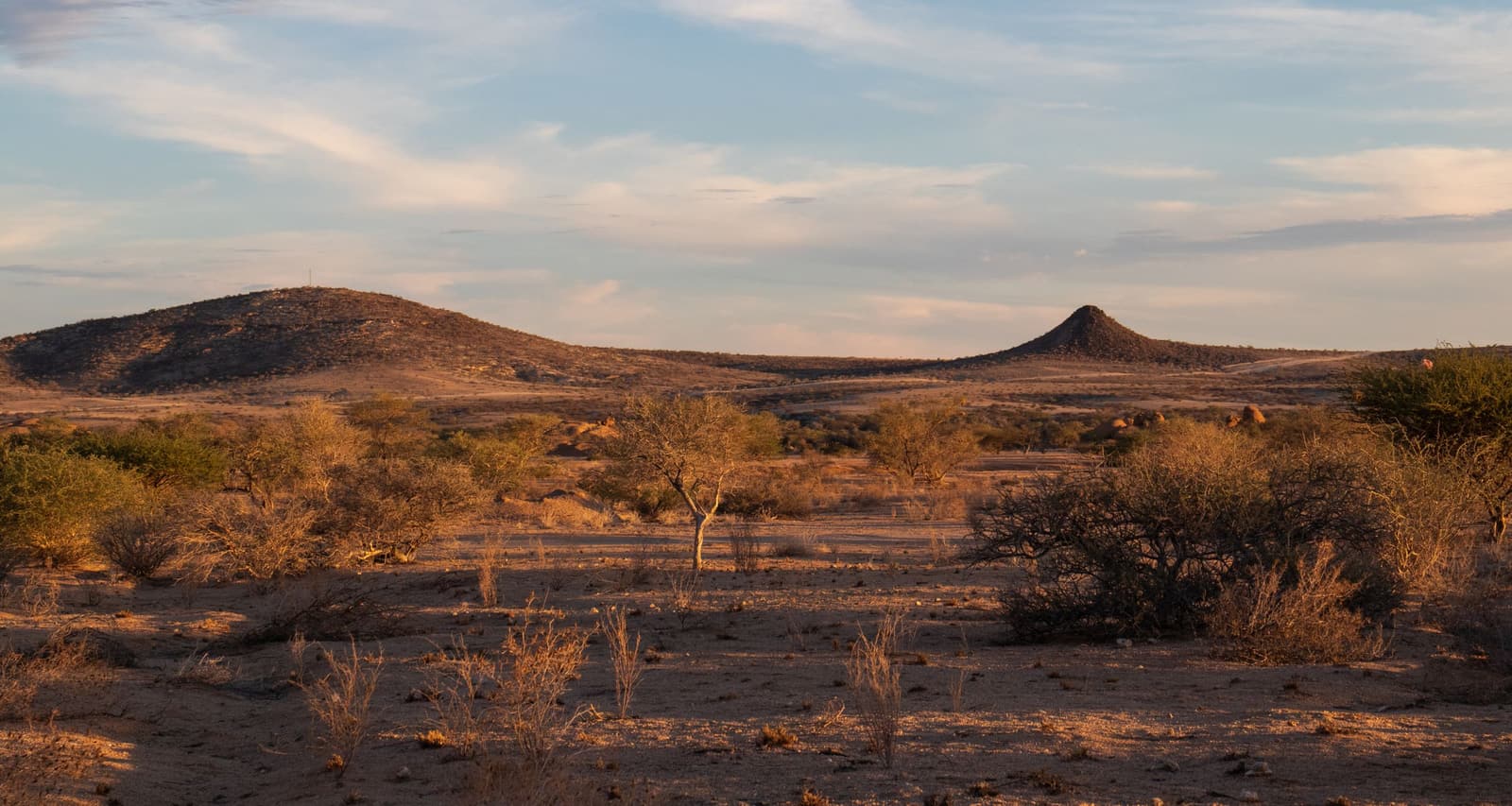
Photographs on this page dim with the page. A screen is the brightest thing on a property like this one, so when the lamp is out these hold 16% of their light and none of their colour — the figure derived from this property’s own 21.85 mag/arcsec², and the colour because a dark-adapted eye is running on rods, which have none.
The rooms
Rates are per night, April to October. Minimum stay 2 nights.
The Stoep Room
Sleeps 2 · NAD 3,400 per night, April to October
The original farmhouse bedroom, with the oldest door on the werf and a ceiling high enough to keep the day off the bed.
Observing. Opens straight onto the stoep, which is where the skyline on this site was measured from. Fourteen degrees of koppie to the west-southwest, and almost nothing anywhere else.
A 90° opening facing WSW, drawn to 35° of altitude. The ridge stands at 14.1° at its highest across this window and drops to 0.7° at 292°, which is where the sky opens from this door. The Lagoon Nebula, The Sagittarius Cluster, Antares, Rigil Kentaurus, The Sagittarius Star Cloud above it right now, 3 of them higher than this strip reaches. 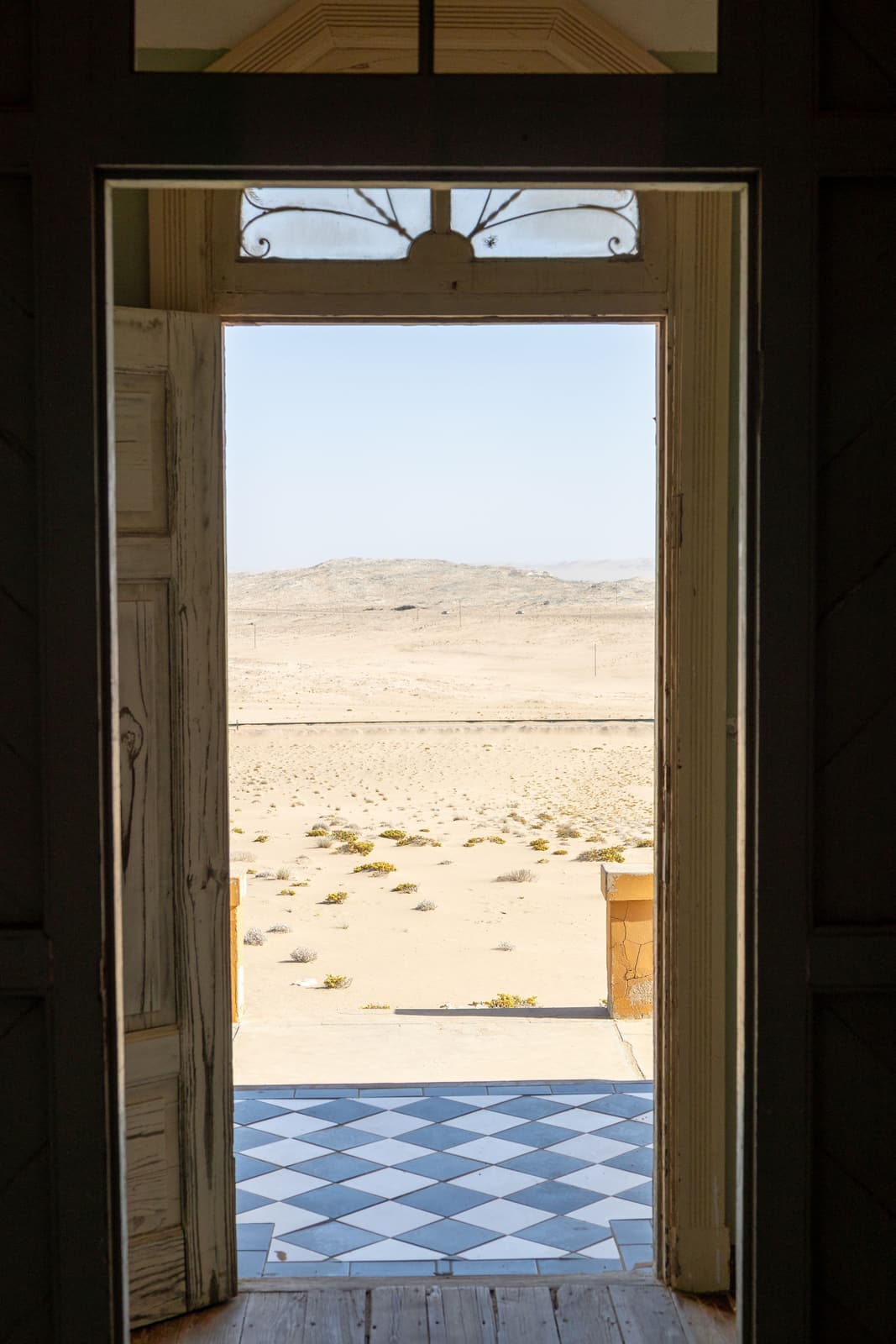
The Shearing Shed
Sleeps 4 · NAD 4,900 per night, April to October
Converted in 2019, keeping the roof trusses and the concrete floor. Two bedrooms, one bath, and a door at each end so the night air moves through.
Observing. The shed itself is the block due north on the skyline. Walk twenty metres south of it and that goes away.
A 70° opening facing N, drawn to 15° of altitude. The ridge stands at 6.1° at its highest across this window and drops to 1.0° at 325°, which is where the sky opens from this door. Nothing on the house list is above it at the moment this page draws. Koppie Hide
Sleeps 2 · NAD 6,200 per night, April to October
One room on the shoulder of the koppie, forty minutes on foot from the werf, supplied once a day. No electricity of any kind.
Observing. Sixty metres above the farmstead and clear of its ridge, so the western sky opens up. The darkest bed on the property, and the least convenient.
A 110° opening facing WNW, drawn to 35° of altitude. The ridge stands at 14.1° at its highest across this window and drops to 0.5° at 300°, which is where the sky opens from this door. The Lagoon Nebula, The Sagittarius Cluster, Antares, The Sagittarius Star Cloud above it right now, 3 of them higher than this strip reaches. The Werf Cottage
Sleeps 6 · NAD 7,100 per night, April to October
Three bedrooms around a walled yard, for a family or a group who would rather be near the kitchen. The yard walls are low enough not to matter.
Observing. The only room with its own red-lit veranda, which means you can go back inside for twenty minutes without starting the adaptation over.
What you look through
The instrument
included
A 12-inch Dobsonian, collimated weekly, kept in the shed and carried out by hand. No tracking, no camera, no screen.
Guided sessions run for whoever is staying, on any clear night the moon is less than a quarter full. There is no charge and no booking.
What the skyline costs you
The skyline from the stoep was measured with a clinometer at 72 azimuths and it is a file on this site, not an impression. It is also the reason the star counts here are lower than a planetarium would give you: tonight the skyline hides 355 of the 4,227 stars above the mathematical horizon.
The highest point on it is 14.1° at azimuth 245° — the koppie the farm is named for. Everything behind it is below the horizon from here, whatever the almanac says is up.
Nothing on this site is a photograph of the sky, so nothing on it can flatter the sky. What the pages show is what the arithmetic gives, including where it is unflattering.