The lamp is on. Almost nothing is visible.
Staying
A byre, a loft, and somewhere out of the wind.
A stone bothy in a plantation clearing, in the first Dark Sky Park in Britain, and it is honest about the three months it has nothing to sell. Every room is described by what it offers an observer as well as by what is in it, because at 21.60 mag/arcsec² the difference between one door and another is measurable.
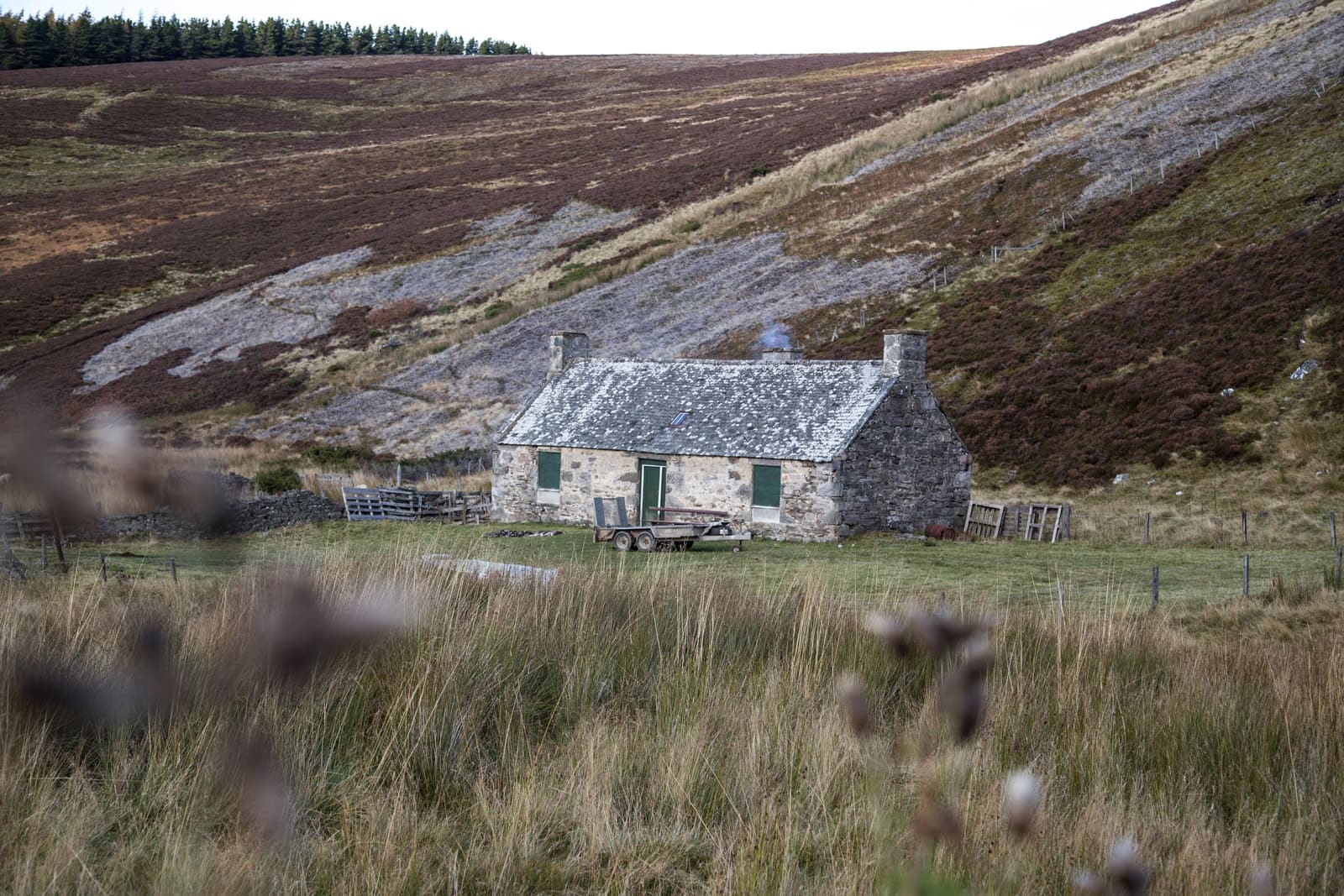
Photographs on this page dim with the page. A screen is the brightest thing on a property like this one, so when the lamp is out these hold 20% of their light and none of their colour — the figure derived from this property’s own 21.60 mag/arcsec², and the colour because a dark-adapted eye is running on rods, which have none.
The rooms
Rates are per night, September to March. Minimum stay 3 nights.
The Byre
Sleeps 4 · GBP 140 per night, September to March
The whole of the ground floor: a room with a stove, a table, four bunks and a stone floor that never gets warm. Water from the burn, filtered. A composting toilet in an outbuilding.
Observing. The door faces the felled break, so you go from the stove to the dark in eleven steps and do not pass a single light on the way.
A 80° opening facing S, drawn to 25° of altitude. The ridge stands at 9.1° at its highest across this window and drops to 0.4° at 195°, which is where the sky opens from this door. The North America Nebula above it right now, higher than this strip reaches. The Loft
Sleeps 2 · GBP 95 per night, September to March
Under the roof, reached by a ladder, with one small window facing south. Warmer than the byre by a long way, because heat goes up.
Observing. The window frames the southern break almost exactly. On a clear February night you can watch Orion cross it without getting out of the sleeping bag, which is not the point but is a good thing to be able to do.
A 40° opening facing SSW, drawn to 15° of altitude. The ridge stands at 4.8° at its highest across this window and drops to 0.4° at 195°, which is where the sky opens from this door. Nothing on the house list is above it at the moment this page draws.
What you look through
The observing shelter
included
Three walls and a roof, open to the south, with a bench at eye height. Red-lit only. Built so you can be out of the wind without being under a sky.
The wind is the thing that ends most sessions here, well before the cold does. This is the difference between two hours out and twenty minutes.
The instrument
included
A 10-inch Dobsonian kept in the shelter, and a pair of 15x70 binoculars on a parallelogram mount. No tracking, no camera.
The binoculars get used more than the telescope, and anybody who tells you otherwise about a sky like this has not spent a winter under one.
What the skyline costs you
The skyline from the felled break south of the bothy was measured with a clinometer at 72 azimuths and it is a file on this site, not an impression. It is also the reason the star counts here are lower than a planetarium would give you: tonight the skyline hides 614 of the 3,888 stars above the mathematical horizon.
The highest point on it is 20.8° at azimuth 20° — Craiglee itself, the hill the bothy is named for. Everything behind it is below the horizon from here, whatever the almanac says is up.
Nothing on this site is a photograph of the sky, so nothing on it can flatter the sky. What the pages show is what the arithmetic gives, including where it is unflattering.